



Preview GP Le Mans MotoGP 2026: Aprilia leading, Ducati on its circuit and the Márquez unknown
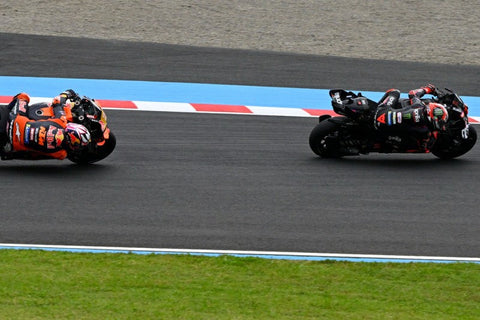
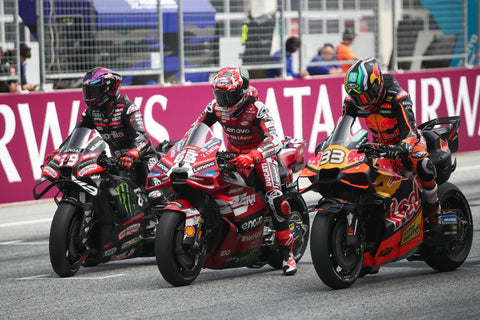
The fifth Grand Prix of the season arrives with the championship turned upside down compared to the preseason script. Aprilia leads the standings with Marco Bezzecchi and Jorge Martín at the front, Ducati seeks in Le Mans the circuit where its Desmosedici has historically performed well, and KTM arrives with two absences and a substitute that has generated debate within the paddock. The preview of the 2026 French Grand Prix has more layers than any other race at the start.
The championship context before arriving at Le Mans
The picture of the world championship after the first races does not fit the March predictions. Bezzecchi and Martín, both with Aprilia, lead the general standings and have made the Noale brand the reference for consistency at the start. Aprilia places four riders in high positions of the table, a collective solidity that contrasts with the scenario of previous campaigns, when it depended almost exclusively on a single leading rider.
Marc Márquez arrives in France with physical doubt hanging over him. The ligament injury suffered at the Indonesian Grand Prix, from the contact with Bezzecchi in the first lap, has affected him in subsequent races. Pedro Acosta has voiced it in the paddock: he sees Márquez less comfortable than in 2025, without the fluidity in braking and direction changes that he showed before the crash. It is not a medical report, it is track reading from a direct rival, but it matches what the sector times show.
The other internal Ducati debate is the balance between factory bikes and satellite team machines. Gresini and VR46 are appearing in positions that their theoretical performance does not justify and that Borgo Panigale's own structure fails to explain. Riders consulted trackside admit that the performance distribution among machines with the same nominal specification is unclear.
Le Mans and the Desmosedici: a favourable circuit
The recent history of the French track is Ducati in a loop. Petrucci in 2020, Miller in 2021, Bastianini in 2022, Bezzecchi in 2023 with the GP22 from VR46 and Martín in 2024 with Pramac. Five consecutive victories that are no coincidence.
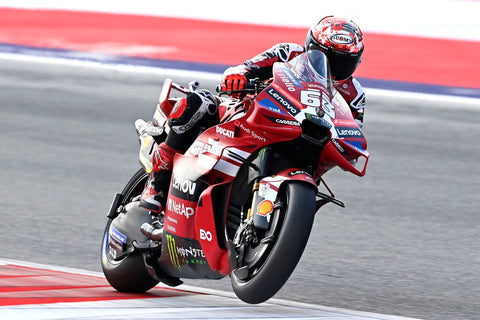
Le Mans rewards the structural qualities of the Desmosedici: hard braking into the slow corners, traction exiting the chicanes and top speed on the short Mulsanne straight. The Italian bike has translated its strengths well to this track year after year. The question of this edition is whether the historical strength of the package compensates for the internal crisis of relative performance of the factory bikes that has been felt since the start of the year.
Aprilia: from leadership to victory
Aprilia arrives in France with the data front and centre: it leads the world championship with two riders, collects podiums regularly and keeps two other men in the top of the table. Bezzecchi has strung together weekends without mistakes and Martín, star signing, is still in the process of adaptation. The rider himself has acknowledged it: he believes he will soon fully master the RS-GP. That is, there is still room for improvement.
That idea is what should worry the rest of the grid the most. If the 2024 champion still does not squeeze the bike to one hundred percent and is already fighting up front, the ceiling of the 2026 Aprilia project is higher than what the standings show today. The doubt at Le Mans is whether a track that has not historically been the domain of the brand can turn consistency into victory.
The KTM unknown: Viñales out, Folger in
KTM lands in France with two absences. Maverick Viñales goes under the knife to have shoulder surgery after Austin and will not be at Le Mans. Pol Espargaró, who was supposed to be the natural replacement option, injured his left hand in a training session. The Austrian structure has opted for Jonas Folger as a replacement, a decision that has raised questions inside and outside the factory, because Dani Pedrosa is in full form as a test rider and, on paper, offered superior performance.
The explanation lies in Pedrosa's strategic role within the development programme: his work on the bench and testing is absolute priority and is not interrupted for a one-off replacement. Folger, with previous MotoGP experience and knowledge of the RC16, is the operational solution.
The episode reopens a fundamental debate. Günther Steiner has called it inconceivable that a manufacturer can halt its bike due to rider injury in a category like MotoGP. The idea, raised sporadically, clashes with the sporting and commercial logic of the championship.
Toprak Razgatlioglu: the debutant under scrutiny
The WorldSBK triple champion faces his first full season in MotoGP and the learning curve is the expected one. Toprak Razgatlioglu has admitted impatience, a known characteristic of his, against the technical reality of the category: different tyres, more complex electronics, front braking with a much narrower margin. Adaptation is measured in tenths, not in seconds, and that requires fine adjustment work that does not fit with his natural aggressive style.
Le Mans is not the ideal track for a debutant. Changeable conditions and the risk of rain in May add variables to a rider who is still building references.
The future of the championship: commercial agreement 2027-2031
Alongside the track, Carmelo Ezpeleta has conveyed confidence in closing the agreement with manufacturers for the 2027-2031 cycle. Negotiations have been open for almost a year and sensitive points remain to be resolved, but the message from MotoGP Sports Entertainment Group is one of optimism. It is a matter that will not be resolved at Le Mans but weighs on the paddock's mood: it defines the economic and sporting framework for the next decade.
Forecast: favourites and wild cards
With the data in hand, the favourites at Le Mans have name and argument. Bezzecchi arrives as leader and with confidence intact. Martín has the circuit on his side, won in 2024, although with a different bike. Any Ducati factory or satellite bike starts as a podium candidate by track history.
The wild cards are two. The first, the actual physical state of Márquez, a variable that will only be measured on Saturday afternoon on the stopwatch. The second, the possibility of rain: Le Mans in May has mixed the cards more than once and has allowed unexpected victories. If water enters the scene, the dry hierarchy is reordered and the debutant with fewer references, Toprak included, pays the heaviest price.
Analytical conclusion
Le Mans 2026 functions as a thermometer. If Aprilia wins, the leadership of Bezzecchi and Martín stops being statistical and becomes structural. If Ducati breaks the streak with an official victory, the internal balance between factory and satellites becomes clear. And if rain arrives, all of the above is suspended. The question that opens the weekend is not who will win, but what championship hierarchy will emerge confirmed from France.


Comments
Be the first to comment.