



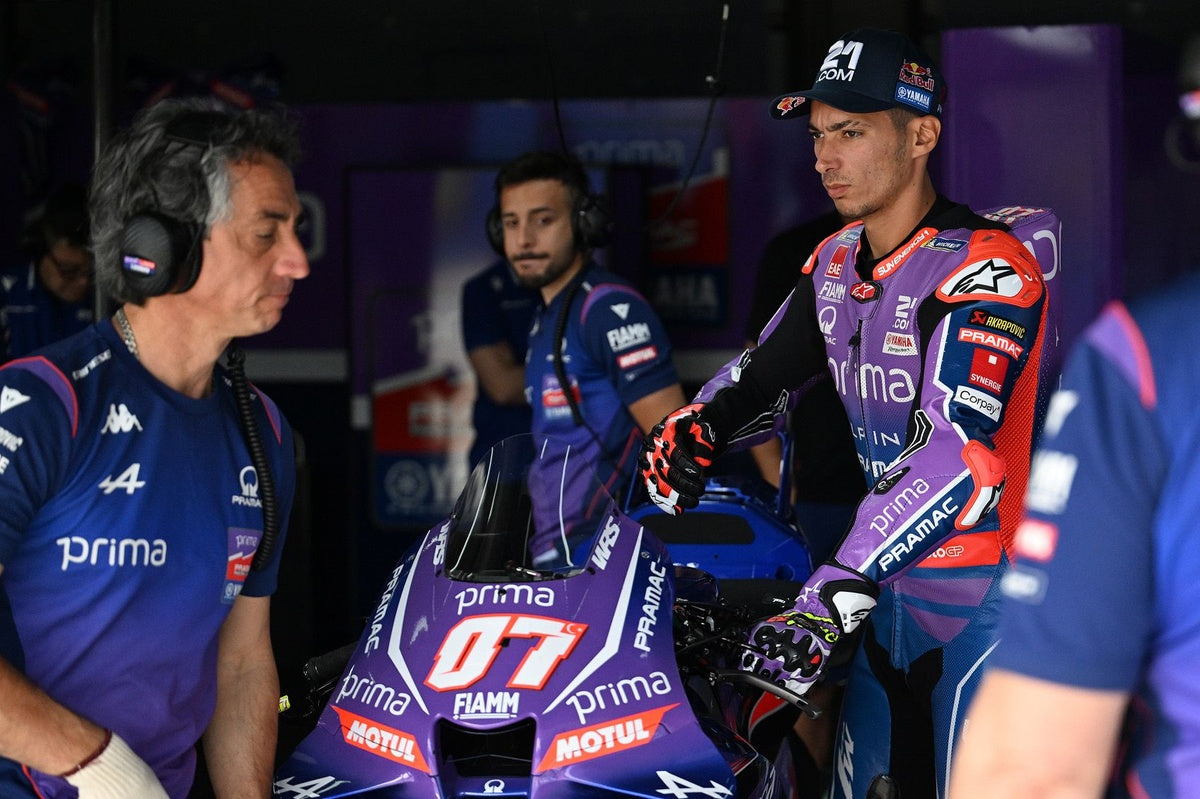
The delicate adaptation of an impatient Razgatlioglu to MotoGP
Toprak Razgatlioglu lands in MotoGP with the credentials of a three-time WorldSBK world champion and with the conviction, expressed in the paddock itself, that the transition should not take him more than a few months. The technical reality that awaits him is considerably less straightforward. Aprilia, his new environment, arrives at this stage of the 2026 season as one of the championship's reference points, with Marco Bezzecchi and Jorge Martín as internal benchmarks. That turns every tenth on track into an uncomfortable conversation.
A world champion who arrives in a hurry
Razgatlioglu's sporting profile needs no introduction. Extreme braking style, aggressive front-end management, and a capacity for sustained attack that in WorldSBK allowed him to break Ducati's dominance and win titles under pressure. In the MotoGP paddock, that record is respected. But it is respected with an asterisk: the premier category has spent years perfecting a prototype that is ridden in a way that bears no resemblance to anything he has done until now.
The real expectation, beyond the media impact, lies in whether his front-end reading, which is his trademark, translates to a Michelin with different thermal behavior and an aerodynamic package that completely reshapes the load distribution in braking and corner entry.
The technical gap between WorldSBK and MotoGP
The jump is not about engine displacement. It is about philosophy. A production Superbike is a highly evolved road bike, with rigid-carcass Pirelli tyres and more predictable behavior lap after lap. The MotoGP prototype is a different sport: aerodynamics that generate real downforce at high speeds, ride-height devices that rewrite corner exit, electronic energy management with maps that change within a single lap, and a rear Michelin whose degradation shapes strategy from lap five onward.
The historical learning curve of riders who have made that crossing is telling. Chaz Davies, Carlos Checa, or Eugene Laverty, to cite references from the same segment, failed in their first MotoGP seasons to convert their Superbike level into equivalent results in the prototype. The reason repeats itself: time is not gained in deep braking, it is gained in how the exit is set up with electronics and aerodynamics working together.
The opening moves: between impatience and reality
Razgatlioglu's public message, captured by paddock coverage, has mixed self-criticism with high personal confidence that the breakthrough will come soon. It is the expected narrative from a champion. The distance, however, is measured on track, and the typical pattern for a Superbike rookie passes through improvements in specific sectors before a full clean lap.
The coherence between what the rider feels and what the stopwatch delivers is, in this transition profile, the most reliable indicator. When both align, the curve accelerates. When they diverge, the risk of forcing the pace too early usually appears.
The Aprilia factor: advantage or ballast at the start?
The RS-GP is going through its best period. Bezzecchi and Martín are setting the pace in the championship and the Noale factory has consolidated a package that competes on equal terms with Ducati on several circuits. For a newcomer, that is both a blessing and a sentence.
The blessing: the bike works, the teammates' data serves as a reference, and development does not depend on the rookie. The sentence: the internal benchmark is extremely high. The measuring stick is not a teammate in the process of adaptation, but two riders fighting for the title. Every session, times are compared against that reference, and the psychological margin for error is narrow.
In that context, team dynamics matter as much as the bike. If Aprilia manages to preserve a parallel development channel for Razgatlioglu, with a realistic test calendar and without pressure for immediate results, the curve can shorten. If external pressure pushes to skip stages, the risk of blocking adaptation grows.
Impatience as asset and as risk
Razgatlioglu's competitive mentality is exactly what gave him titles in WorldSBK. Constant attack, zero acceptance of second place, ability to hunt the rival's wheel even when the team asks for management. Carried into MotoGP, that mentality has a double edge. It pushes in the right direction when there is need to take risks to understand the prototype's limits. It penalizes when it leads the rider to chase times before establishing the technical foundation.
The lesson from recent rookies is that learning the prototype is not measured in early victories, but in the consistency with which the gap to the leader reduces lap after lap and race after race.
What he needs to make the jump to the next level
The elements the paddock identifies as critical are three. First, recalibrate braking to extract real aerodynamic load instead of loading the front end like he did in Superbikes. Second, read the rear Michelin degradation and adjust his style at race mid-point, when the prototype changes behavior. Third, integrate electronic tools, maps, wheelie control, ride-height management, as an active part of riding, not as a layer the team adjusts for him.
Realistic timelines, according to the historical pattern of transitions from WorldSBK, place the turning point in the second half of the first full season. The 2027 season, with a full winter of prototype development work, is usually the real test.
Frequently asked questions about Razgatlioglu's arrival in MotoGP
Why did Razgatlioglu take so long to make the jump to MotoGP?
The jump from WorldSBK requires the alignment of three factors: an offer from a competitive project, contract conditions that free the rider, and a sporting moment that justifies the change. That combination had not come together before on terms the rider's camp considered reasonable.
What is the difference between WorldSBK and MotoGP in terms of technical difficulty?
The key difference is not power, it is the integration between aerodynamics, electronics, and tyre. The MotoGP prototype requires riding the bike while simultaneously managing tools that either do not exist in WorldSBK or are limited, from ride-height devices to maps that change mid-lap.
Is it realistic that he will fight for the title in his first full season?
The historical precedent of riders who cross from Superbikes to the prototype does not support that expectation. A reasonable goal for a first season is to consistently reduce the gap to the leader and compete for top positions in the second half of the year. The title, in the best of scenarios, would come later.
Conclusion
The question that defines Razgatlioglu's season is not when he wins his first race. It is how many tenths he reduces, sector by sector, compared to Bezzecchi and Martín between the first Grand Prix and the last. That is the indicator that separates the champion in transition from the champion established in a new category. And that figure, unlike the headline, admits no impatience.


Comments
Be the first to comment.