



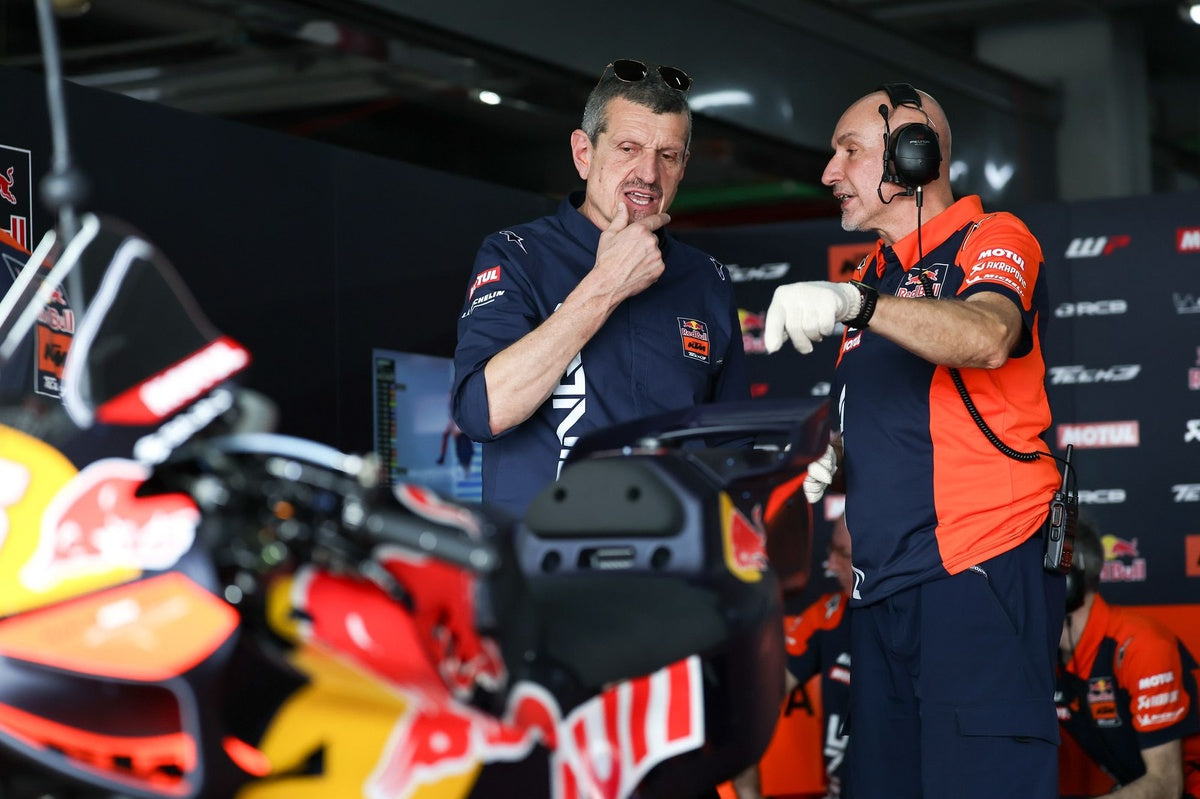
Stop a MotoGP for a test rider's injury? "Unthinkable", according to Steiner
KTM has a double problem. Maverick Viñales is sidelined after surgery. Pol Espargaró, his test rider and key figure in development, is also out injured. And the question circulating in the paddock is not whether you can replace a race rider: it is whether it even makes sense to consider stopping a motorcycle's development mid-season.
Günther Steiner's answer came quickly and without nuance: unthinkable.
The context: KTM accumulates injuries at the worst possible time
Viñales has been dealing with shoulder issues and his recovery affects several calendar dates. The absence of the test rider, Pol Espargaró, comes on top of that. We are talking about the person who logs miles between races, validates updates and filters what reaches the race riders and what stays off the bike.
It is not a decorative role. A test rider in MotoGP fulfils three basic functions:
- Collects data at private circuits with parts that have not yet been homologated.
- Validates or discards updates before they enter an official garage on race weekend.
- Covers occasional wildcards to gather information in real race conditions.
Without that active figure, the development cycle slows down. And the MotoGP calendar does not wait.
Who is Steiner and why his opinion circulates
Günther Steiner became known outside motorsport circles. Former Haas team principal in Formula 1, his media profile grew with the Netflix series and since his departure, he has gained presence in other paddock environments, including MotoGP.
His statement, reported by motorsport.com in its French edition, goes beyond the headline. Steiner is not talking about postponing races: he is talking about the idea, raised theoretically in the paddock, of halting a manufacturer's development programme because the rider in charge of testing cannot ride. For someone coming from F1, where development never stops, the proposal simply does not hold up.
The nuance matters. It is not the same thing to lose a test as to lose a race. But in MotoGP, where homologation windows are rigid and update deadlines are fixed, losing weeks of testing can end up costing tenths on track for months.
What stopping development mid-season implies
The test rider works against the clock. The windows for introducing technical changes are regulated and decisions about which parts reach the race rider are made with data. If that data is not generated, the track engineer works blind.
KTM's options, on paper, are three:
- Bring in an external or former rider who can test privately to maintain the flow of information.
- Rely on the race riders themselves (Brad Binder and Pedro Acosta) for validation tasks in the official calendar tests, at the cost this entails for their race preparation.
- Accept the partial halt and reorganise homologation priorities.
None is free. And none fully replaces an experienced test rider familiar with the manufacturer's chassis and electronics.
The broader debate: the role of the test rider
KTM's situation reopens a discussion that surfaces in MotoGP every few seasons. Test riders are structural pieces of the championship, but their public exposure is minimal and substitute coverage is limited. When one goes down, there is no deep bench to draw from.
Carmelo Ezpeleta, CEO of Dorna, has stated repeatedly that the championship will continue negotiating with manufacturers the technical frameworks ahead. The question is whether in those conversations the role of the development rider and his replacement in cases of prolonged injury is also being reviewed.
What is the difference between a race rider and a test rider in MotoGP?
The race rider competes on Grand Prix weekends and scores championship points. The test rider does not compete regularly: he rides in private sessions and official tests to develop parts, evaluate updates and occasionally participates as a wildcard in a specific race.
Can KTM use another rider while Espargaró recovers?
On paper, yes. The regulations allow hiring riders for testing tasks. The practical difficulty is finding someone with prior knowledge of the bike and immediate availability, two conditions that rarely coincide mid-season.
What does homologation mean in MotoGP?
It is the process by which a component (engine, aerodynamics, chassis in some aspects) is registered and authorised for race use. There are defined periods in which changes can be introduced. Outside those windows, modifications are frozen until the next period.
What is really at stake
Steiner's remark works as a headline, but the foundation is structural. The real risk for KTM is not stopping the bike: it is reaching the next homologation windows with incomplete data and decisions made without the usual validation. That gets paid in the stopwatch for months, not over a single weekend.
The open question is whether MotoGP, as a championship, should review the development model and the protection of the test rider role. For now, the institutional response remains the same as always: the calendar rules and development does not stop.


Comments
Be the first to comment.